
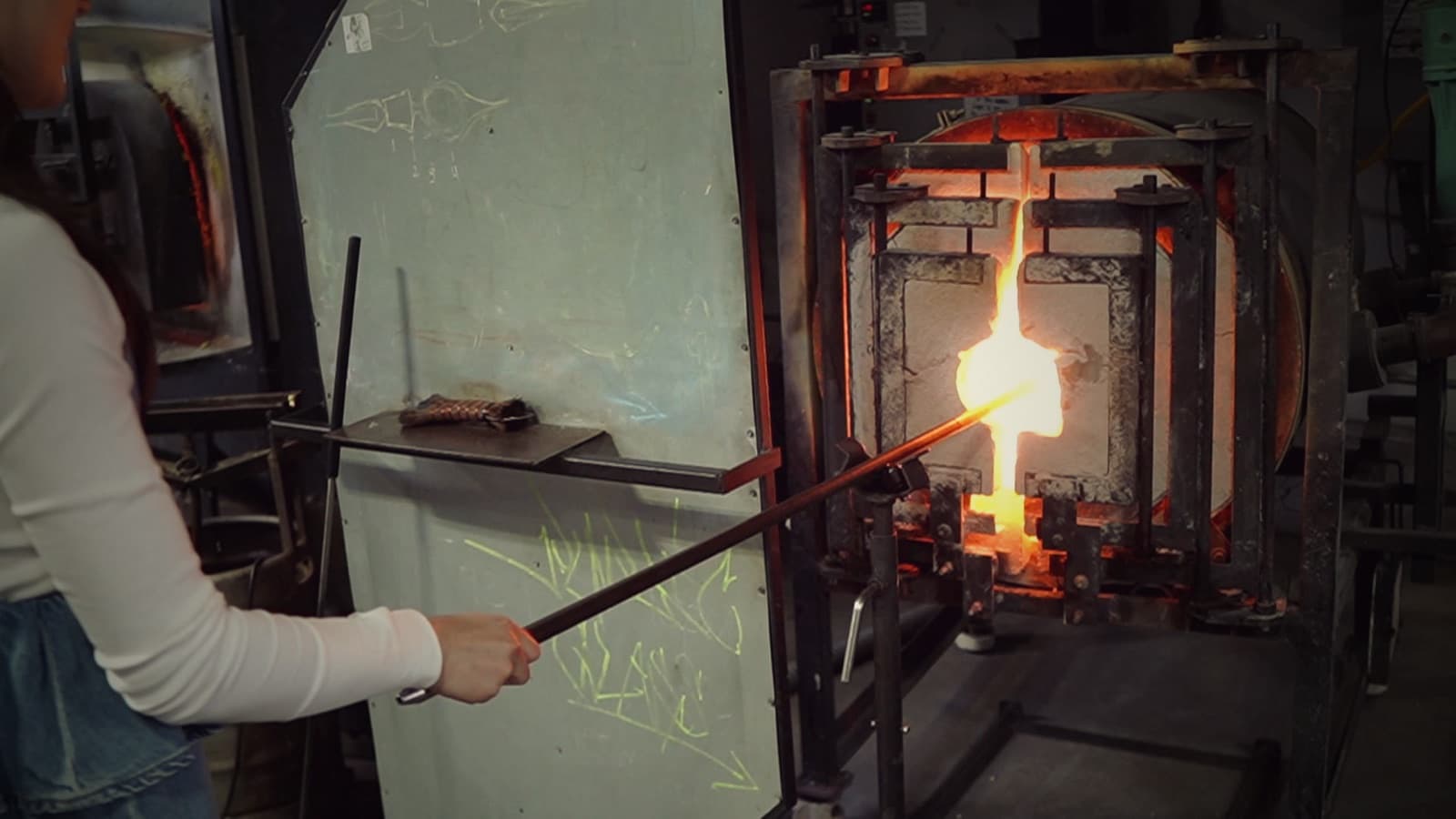
How to become a glassblower: take an introductory hot-glass class at a public-access studio or a craft school, then buy or trade for enough bench time to move glass reliably. From there, work as a studio assistant on somebody else's team, learn the gaffer's rhythm from beside the bench, and build toward gaffing your own pieces or renting furnace time for independent work.
Because glass runs on a furnace almost nobody can keep at home, every step below is really a question of access to someone else's hot shop.
What the assistant-to-gaffer ladder actually means
Unlike trades where one person carries a piece start to finish, hot glass assigns roles by position around the bench, since large or complex work needs, per Wikipedia's entry on glassblowing, "a team of several glassworkers, in a complex choreography of precisely timed movements." UrbanGlass, the public-access studio in Brooklyn, defines a gaffer in its glossary as "The person in charge of the blown glass piece. If working in a team, they are the lead person on the team," and reserves soloblowing for one working alone.
That shorthand compresses a much older ladder. English glass manufacture organized workers into teams called chairs of four, and in the American shops documented by the Society for Historical Archaeology, the gatherer held the lowest-skilled position, passing molten glass from the furnace opening to the servitor, "the master blower's first assistant," who marvered it before the gaffer worked it. Murano's Gambaro e Tagliapietra keeps Venetian words for the same structure, describing its piazza of four to eight as "capable of making an entire piece from start to finish."
| Rank | Tradition | What the job is |
|---|---|---|
| Gaffer | English chair, U.S. studios | Leads the team and shapes the piece |
| Maestro | Murano piazza | Runs the piazza of four to eight |
| Servitor | American shop | First assistant; marvers the gather for the gaffer |
| Servente and serventín | Murano piazza | Chief assistant, then third in command, an apprentice trusted with skilled tasks |
| Gatherer | American shop | Collects molten glass from the furnace opening |
| Footmaker | Georgian stemware | Blows the foot "in the same way as the bowl," joins it to the stem |
Note: the chair was rarely uniform, and Barnett (1926), as cited by the SHA, puts a typical American shop at seven people, three skilled workmen and four boys.
American studio glass inherited that ladder and shrank the room around it, beginning in 1962 in a garage on the Toledo Museum of Art grounds, where ceramics instructor Harvey Littleton organized the workshops, Dominick Labino supplied furnace-design help, and Harvey Leafgreen, a former Libbey glassblower, gave the demonstrations. Their small furnace let one artist work glass outside the factory team, though a chair still beats a soloist on anything sizable, so the ranks survived. Glass sits at the center of the Venn diagram between fine arts and skilled trades, carrying the artistry and aesthetic of the one with the training and rigor of the other, distinct from the licensed tradesman and the hobbyist.
Where to train: glassblowing schools, craft schools, and access studios
Unlike the licensed trades, glassblowing has no credentialing exam, and glassblowing training clusters into three formats, the first of which houses glass inside an art school. RIT offers a Studio Arts BFA with a Glass Option covering glassblowing, flameworking, and casting, MassArt runs a BFA and a minor in glass, and Temple's Tyler School of Art and Architecture teaches hot glass, casting, neon, and stained glass in some 10,000 square feet of studio space.
However, craft schools sell immersion where the degree programs sell credentials. Pilchuck Glass School in Washington runs guest-artist-led sessions, most about two weeks, with applications opening the previous autumn for scholarships and assistantships. Penland School of Craft teaches one- to eight-week workshops in blown, fused, and cast glass, capping hot glass at twelve students across three blowing stations, and Haystack Mountain School of Crafts in Maine, founded in 1950, runs one- and two-week workshops at every level.
Plus, access studios rent out the furnace itself. UrbanGlass calls itself an "open-access facility where over 380 professional artists and designers create using glass," renting shared hot shop, kiln, and flameworking time by the hour. Public Glass in San Francisco, Pratt Fine Arts Center in Seattle, Pittsburgh Glass Center, and Foci MCGA in Minneapolis work the same way, Foci around two 400-pound furnaces where "molten glass is always ready to use."
Furnace access is the practical gate on this craft, and studio rental terms show what getting through it costs in time. UrbanGlass runs six glory holes and two 1,000-pound furnaces that renters share by the hour and bills annealer space by the 24-hour period, since a cooling cycle keeps running long after you go home. Pratt sells hot shop time in four-hour blocks for a team of up to three, priced for a crew instead of a soloist.
How to become a glassblower: the six-step path
Most people who start a glassblowing career start inside somebody else's hot shop, and the steps below follow the order access tends to open up.
1. Get your first bench time
Introductory hot-glass classes assume no experience at all. UrbanGlass's Intro to Glassblowing is a six-session weekly class open to ages 14 and up, and GlassRoots in Newark runs a free single-semester apprentice program for nine students a term, ages 18 to 26, with priority for BIPOC-identifying Newark residents, who work beside professionals pulling glass at 2,100°F.
2. Buy, trade, or earn repetition
However you found the first class, the second problem is volume, and work-trade is the standard workaround. Foci MCGA's Time-Trade Studio Assistant Program asks three to six hours a week from applicants who have finished its core glass class and can show financial need, with three hours worked earning a point toward studio rental. Bloomington Creative Glass Center's apprenticeship opens with 12 volunteer hours and a safety training.
3. Land a first glass studio assistant job
Small hot shops tend to hire through their own careers pages and a direct email instead of a job portal. Luke Adams Glass Blowing Studio in Norwood, Massachusetts and The Furnace in Lakewood, Colorado both post that way, and both want people who already have hours in glass, at the bench or teaching make-your-own workshops. A glass studio assistant job is seldom a zero-experience opening, so earlier repetition is what carries the application.
4. Build speed on production work
Production runs are where hands get fast, since repeated forms teach timing in a way a one-off piece cannot. Pilchuck's skill tiers give a yardstick, defining beginner as zero to one year of frequent practice, intermediate as two to four years, and advanced as five or more. Programs write eligibility against those middle tiers, and even the Pilchuck Fellowship wants two to three years of glass behind an applicant.
5. Move up the chair
Moving from assistant to gaffer happens inside a team, on someone else's clock, and it can go faster than folklore suggests. Glass artist Randy Walker's published résumé traces the ladder at one institution: hot glass assistant to William Morris and staff at Pilchuck in 1990, gaffer assistant in 1992, gaffer in 1994, faculty in 1995.
6. Rent furnace time and take independent work
Independence in glass usually arrives through renting, and fellowships bridge the gap in between. The Pilchuck Fellowship pairs a student workshop session with a paid working session and calls itself "a springboard for these artists who are looking to launch their artistic glass career," while its Emerging Artists in Residence program adds a stipend, travel, and housing. WheatonArts' Creative Glass Center of America Fellowship supplies 24-hour studio facilities, housing, and a stipend, reporting of its alumni that "The majority remain active as artists, exhibiting in major galleries and shows."
How long it takes, and what the work asks of your body
Formal preparation in glass is short while skill acquisition is long. O*NET rates the occupation Job Zone 1–2, typically a high school diploma or GED plus on-the-job training of a few days to one year, and its respondents split on schooling: 43% reported that less than a high school diploma was required, 34% a high school diploma, and 20% a post-secondary certificate. Against Pilchuck's five-or-more years of frequent practice for advanced work, however, that window describes the entry and not the climb.
Documentation of the physical toll is unusually specific. O*NET's work-context data reports that 99% of workers face minor burns, cuts, or stings daily and 56% work in very hot or cold conditions daily. Chronic infrared exposure also produces glassblower's cataract, an eye condition that develops after decades and reaches blacksmiths too, so eye protection and a strength base belong in the training from the first week. Careers run long anyway: Glenn Ziemke began blowing glass in 1976 as a university student, apprenticed for a year after his 1978 degree, and stayed in the business 46 years, retiring in May 2022 over "physical exhaustion from almost three decades beside a furnace," per his studio's site, which counted the years at his last two shops.
Scientific glassblowing, the credentialed alternative route
Alongside studio glass runs a technical trade supplying laboratories, and it credentials through a single degree program. Salem Community College in Carneys Point, New Jersey runs a four-semester associate degree in Scientific Glass Technology that its own page calls "the only program of its kind in the nation," pairing glassblowing technique with laboratory fabrication, technical drawing, and chemistry, and an independent directory of glassblowing schools corroborates that Salem currently stands alone in granting it.
Graduates go into aerospace, pharmaceutical development, and semiconductor production, and the program names employers including 3M, GE Global Research, and Argonne National Laboratory, with nearly 100 percent hired within six months across a three-year measured period. Its professional body, the American Scientific Glassblowers Society, was founded in 1952, reports approximately 650 members, and runs an employment section for postings. Note: ASGS publishes no historical membership counts, so no trend reads from that number.
The two lanes separate on pay, and both sit inside a federal category broader than glass. O*NET's combined code, Glass Blowers, Molders, Benders, and Finishers, reports a 2025 median of $22.20 an hour, or $46,170 a year, which the Bureau of Labor Statistics publishes at the level of Molders, Shapers, and Casters, Except Metal and Plastic, so it is a median for employed production work across a family of hand-shaping trades and not a ceiling for glass. Scientific glassblowing pays well above it, and the top of studio glass runs higher still, since William Morris's "Sable Antelope" sold for $290,500 including buyer's premium at Bonhams in June 2013. Our companion piece on what glassblowers actually earn takes the segments apart.
Frequently asked questions about how to become a glassblower
How long does it take to become a glassblower?
Entry is quick, since O*NET puts the occupation in Job Zone 1–2, with on-the-job training of a few days to one year. Mastery takes far longer, and Pilchuck's skill tiers define beginner as zero to one year of frequent practice, intermediate as two to four years, and advanced as five or more.
Do you need a degree to become a glassblower?
No degree is required for studio glass. O*NET's respondents split on the requirement, with 43% reporting less than a high school diploma, 34% a high school diploma, and 20% a post-secondary certificate. BFA and MFA programs at RIT, MassArt, and Temple's Tyler School buy studio access, critique, and time. Scientific glassblowing is credentialed at Salem Community College.
How do you get a job as a glass studio assistant?
Usually by emailing a studio directly, with hours already on your hands. Small hot shops such as Luke Adams Glass Blowing Studio in Massachusetts and The Furnace in Colorado hire through their own careers pages, favoring candidates who have worked at the bench or taught workshops. Work-trade programs are how most beginners accumulate those hours.
Can you learn glassblowing without your own studio or furnace?
Yes, and most people do. Public-access studios including UrbanGlass, Public Glass, Pratt Fine Arts Center, and Foci MCGA keep large furnaces hot and rent glory-hole time by the hour. Work-trade programs such as Foci's Time-Trade Studio Assistant Program exchange a few hours of labor a week for studio credit.
Where to look next
Furnace access, not desire, gates this craft, and a search can shorten the hunt for shops and funding. While the craft is old, the way you find the work doesn't have to be. Our intention is to use the most advanced tools we have to support the most ancient work we do.
Browse open roles on The Corral's jobs board and turn on job alerts so new postings reach you. Residencies, fellowships, and grants sit on our opportunities page, and artisans cluster on the Artisan Map.
For the money, read what glassblowers earn and artisan trade salaries, and for a structured route see artisan apprenticeships or ask about apprenticeships. If you are still weighing trades, try what counts as an artisan trade, an artisan job with no experience, or how to become a blacksmith.