
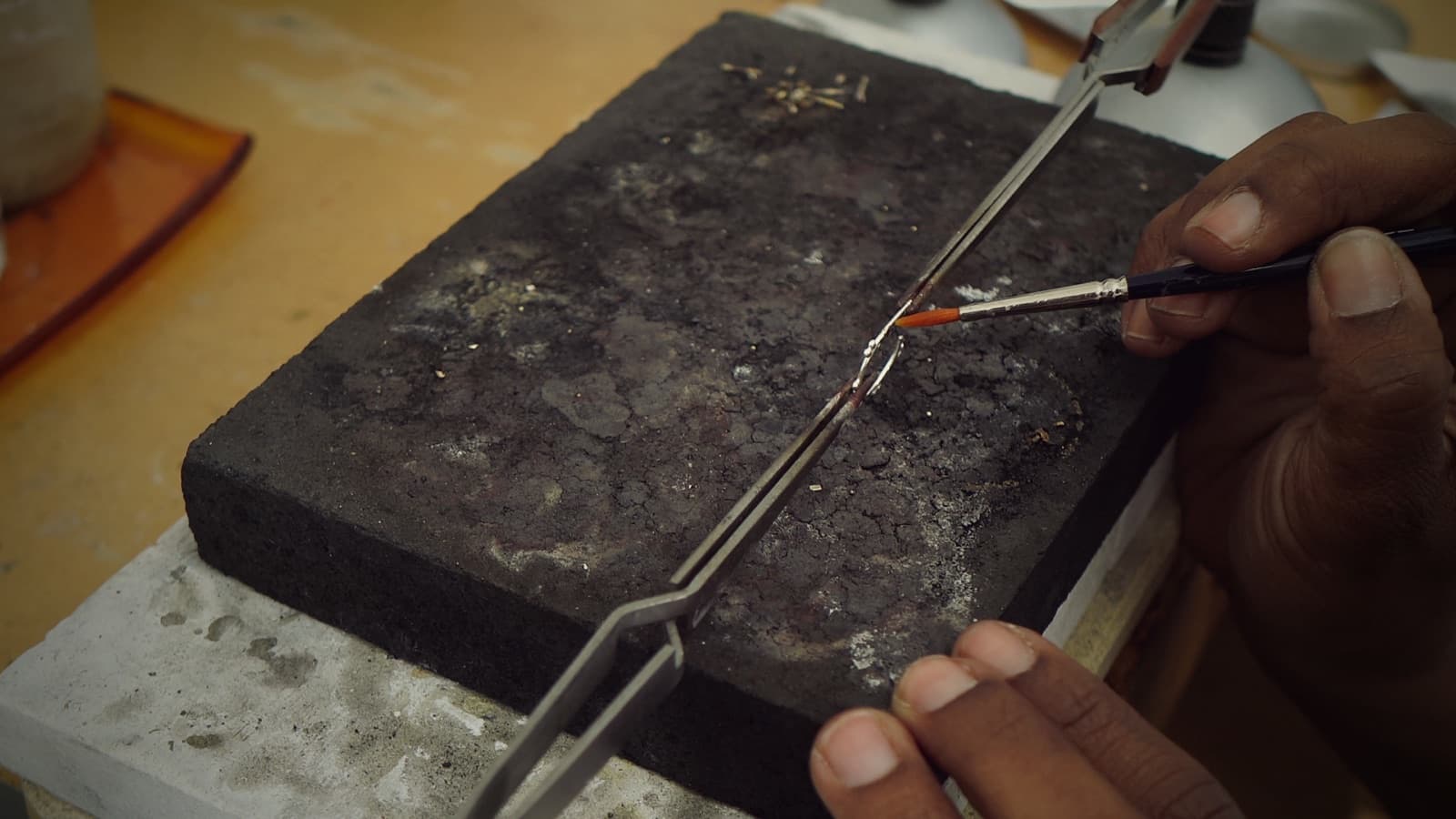
Finding a paid artisan apprenticeship means working two channels at once. Search apprentice-titled openings on craft job boards and inside the federal registered-apprenticeship system, where wages rise on a set schedule. Then approach shops directly, because many craft apprenticeships are filled without a posting ever going up. Judge each one on four things: real pay, structured instruction, bench time, and a named mentor who has agreed to teach you.
What a paid artisan apprenticeship actually is
The Department of Labor's definition works as a measuring stick even for shop arrangements outside the registered system. A Registered Apprenticeship gives you structured on-the-job training with an experienced mentor, classroom instruction matched to the employer's training needs, a progressive wage that rises as skill and productivity increase, industry-vetted standards, and a portable credential on completion.
The wage clause is the one worth reading closely, because it describes a curve rather than a floor. An apprenticeship is a teaching relationship first, and in the early months a master artisan is generally giving more than they are getting: the bench time, the material you spoil, and the attention that comes off their own work. What the registered model insists on is that the balance shifts, and that your pay shifts with it as your hands get useful. A shop that pays you a little at the start and more as you become productive is running the model as intended, while one whose numbers never move regardless of what you can do has stopped teaching and started staffing.
Unlike a flat entry wage, the registered ladder moves on a schedule. Across the FY2014 to FY2024 decade, registered apprentices' entry wages averaged $18 an hour and their completion wages averaged $32 an hour, roughly 77% growth, per a Department of Labor dataset analyzed by the Project for Middle Class Renewal at the University of Illinois Urbana-Champaign. That $18 average spans all registered apprenticeships rather than the craft trades alone, though it lands right where entry-level artisan work starts. Note: published completion rates are worth reading with care, since people leave apprenticeships for reasons that have nothing to do with the shop teaching them, from moving to money to simply discovering the work is not theirs. A programme's completion figure is a poor proxy for whether the training inside it is any good. New York State's labor department puts the mechanism plainly: apprentice wages typically start at about 40% of the full skilled-worker rate, with sponsors required to raise pay along an agreed scale toward journey-level.
An internship is a different instrument under the same law, and Apprenticeship.gov's own comparison describes internships as "usually short term (1-3 months)" against apprenticeships that are "longer term (1-3 years)," and notes that internships "are often unpaid" and "typically do not lead to a credential."
Unpaid arrangements also carry legal weight that shops sometimes wave off. Since January 5, 2018, the Department of Labor has used a seven-factor "primary beneficiary test" to decide whether an unpaid intern is legally an employee, weighing among other things whether the work complements rather than displaces paid staff. Washington State is stricter still, holding training lawful to leave unpaid only when all four conditions are met, among them that attendance is voluntary and no productive work is performed. Producing saleable goods for free is productive work, which is the condition that rule turns on.
| Arrangement | Who pays whom | Typical length | Instruction | Credential |
|---|---|---|---|---|
| Registered apprenticeship (DOL) | Employer pays you on a rising scale | 1–3 years | On-the-job training plus classroom | Portable, nationally recognized |
| Paid shop apprenticeship (unregistered) | Employer pays you, terms set privately | Varies by shop | Whatever the shop commits to in writing | A reference and a portfolio |
| Unpaid internship | Neither party pays; legally constrained | 1–3 months | Educational, often tied to school | Typically none |
| Craft school program | You pay tuition | Months to a few years | Full-time bench instruction | School certificate or diploma |
Note: this table describes the registered system's own official language and the legal shape of each arrangement, not a rulebook every workshop follows. Most craft apprenticeships in the United States sit outside the registered system entirely, and a good unregistered one negotiated directly with a shop can teach more than a formally registered placement. Use the rows as a vocabulary for asking better questions rather than as a test a shop passes or fails.
How to find an artisan apprenticeship: where they get posted, and where they don't
Apprentice-titled roles do get posted by real employers, and they cluster in bench jewelry, repair work, and food craft. Employers that recruit at this level range from established craft manufacturers to national retail chains — Signet Jewelers, Dormont Manufacturing, and Dandelion Chocolate have all recruited under apprentice titles. Repair sits inside that cluster too, so restoration and repair shops are worth working as hard as the maker shops.
The federal system has also standardized the job titles used for craft work, which matters because those titles are often the exact words in a listing. O*NET publishes the titles "vetted by industry and approved by the U.S. Department of Labor for use in a Registered Apprenticeship Program" occupation by occupation.
| Occupation (O*NET code) | Median Pay (2025) | Approved titles | Examples |
|---|---|---|---|
| Jewelers and Precious Stone and Metal Workers (51-9071.00) | $52,540 | 17 | Jeweler; Bench Hand (Jewelry-Silver); Stone Setter (Jewelry); Silversmith |
| Cabinetmakers and Bench Carpenters (51-7011.00) | $46,680 | 9 | Cabinetmaker; Violin Maker Hand; Pipe Organ Builder; Harpsichord Maker |
| Shoe and Leather Workers and Repairers (51-6041.00) | $37,800 | 7 | Bootmaker, Hand; Saddle Maker; Harness Maker; Shoemaker, Custom; Shoe Repairer |
| Tailors, Dressmakers, and Custom Sewers (51-6052.00) | $41,640 | 6 | Custom Tailor (Garment); Dressmaker; Furrier; Alteration Tailor |
| Glass Blowers, Molders, Benders, and Finishers (51-9195.04) | $46,170 | 5 | Glass Blower; Glass Blower, Lab Apparatus; Glass-Blowing-Lathe Operator |
| Potters, Manufacturing (51-9195.05) | $46,170 | 2 | Model Maker (Pottery & Porc); Pottery Machine Operator |
| Furniture Finishers (51-7021.00) | $44,540 | 1 | Furniture Finisher |
| Watch and Clock Repairers (49-9064.00) | $67,230 | 1 | Watch Repairer |
| Woodworkers, All Other (51-7099.00) | $44,530 | none listed | — |
| Metal Workers and Plastic Workers, All Other (51-4199.00) | $45,950 | none listed | — |
Leatherwork is the quiet surprise in that list, since shoemaking, bootmaking, saddlery, and harness work all carry their own approved titles, which is more federal recognition than woodworking's catch-all code gets. The two bottom rows are worth noticing for the opposite reason: blacksmithing falls into a residual metalworking code that carries no approved apprenticeship title at all, so a smith looking for a registered programme is searching a category the system never built for them. That absence is a real part of why so much craft training happens by handshake.
Note: an approved title tells you a craft can be registered, not that many people are enrolled under it, which makes these lists most useful as search vocabulary — the exact words to type into a job board — rather than as a headcount.
We keep the posted side of this in one place: apprentice and trainee openings across the trades sit on their own page of the board, so you can read the current crop without filtering the whole thing yourself.
Several maker apprenticeship programs recruit on a published calendar. The National Park Service runs the Traditional Trades Advancement Program, a paid internship of roughly 8 to 26 weeks covering masonry, carpentry, and window restoration. Abroad, the luxury houses run the largest craft-training pipelines in the world: the École Hermès des savoir-faire trains apprentices toward the French national leatherwork diploma, and LVMH's Institut des Métiers d'Excellence has trained more than 3,300 apprentices since 2014.
However, there's another market, the one that rarely reaches a listing page. Many craft apprenticeships are filled without a public posting, and ceramics is the clearest documented case: after the UK's formal ceramics apprenticeship system collapsed, an estimated 1,500 professional studio potters now sustain skills transmission mainly through informal, community-based teaching networks, per research in the journal Vocation, Technology & Education. Heritage Crafts names a lack of structured training among the pressures pushing UK crafts toward extinction.
The same pattern shows up in individual careers. Apprentice bladesmith Eric Chevallier's training under Japanese master swordsmith Hirakawa in Sasuke began not through an application but after he worked as a French translator for one of the master's exhibitions in France. Closer to home, Brooklyn blacksmith Marsha Trattner of She-Weld, a guest on our sister show The Trades Show, came to the craft in the 1990s after meeting a woman who forged with her husband and taught her the technique, with no program involved.
Published career guidance reflects that norm. Indeed's blacksmithing advice tells aspiring apprentices to email local smiths even if they see no openings, treating the absence of a posting as normal rather than as a closed door. Our blacksmithing guide walks that path in one trade.
How to evaluate an artisan apprenticeship before you commit
Four tests separate a genuine craft trade apprenticeship from an unpaid pair of hands: it pays, it teaches on a plan, it puts you at the bench, and it names the person responsible for teaching you.
It pays, and the pay moves. In a Department of Labor-commissioned study of nearly 2.8 million apprentices, 76% earned starting wages of $15 an hour or more, and 95% earned at least that much by completion. The front end is where the strain shows, since only 56% met MIT Living Wage Calculator standards at program start, a figure that climbs to 92% by completion. Early apprenticeship is lean, and a program worth taking is explicit about when it stops being lean.
It teaches on a plan. Craft Education, an apprenticeship platform run as part of Western Governors University's nonprofit mission, describes strong programs as giving mentors a coaching framework of "observe → model → practice → feedback", with scheduled touchpoints correlating to higher completion. Craft Education's list of failure signs is usable in an interview: apprentices "left guessing instead of learning," mentors who feel "overwhelmed or unsure of expectations," and "inconsistent or unclear evaluations."
It puts you at the bench. Practice is the third step in that coaching sequence, and it is the one an arrangement can quietly skip while still keeping you busy. Ask what a normal week holds: hours at the bench, hours on shop upkeep, and what work you will be trusted with by month six. Entry-level tasks are a legitimate starting point, so the useful question is less whether you will sweep than when you will stop.
It names a mentor. Ask who will teach you, how often, and what happens when that person is on deadline. The relationship carries more weight than the paperwork, which is why the Japanese framing remains the sharpest available. Bamboo artist Tanabe Chikuunsai IV describes the tradition this way: "Deshi means apprentice – not just an employee, but one who is also joining the daily life with a master". Those apprenticeships commonly run about a decade, with sushi-chef training taking up to ten years to reach master level and silk-kimono apprenticeships spanning roughly the same.
Plus, completion rates are worth checking before you sign. Analysis from Jobs for the Future finds the registered system losing roughly 150,000 to 160,000 apprentices to cancellation each year against about 120,000 completions, with 46.8% completing within six years. The same analysis counts 702,000 active apprentices in FY2025, up 77% from 396,000 in FY2016, though year-over-year growth peaked at 6.2% in FY2023 and has slipped since. The system is large and grew substantially over a decade, but its expansion has plateaued.
The ladder's top end is worth knowing before stepping onto the bottom rung. Each figure below is a median for employed production work rather than a ceiling, and our artisan trade salaries guide documents the tier above it, where bespoke boots from a maker like Lisa Sorrell start at $10,000 a pair and established names with waitlists reach six figures, which is real but uncommon.
| Trade | Median Pay (2026) | Apprentice track |
|---|---|---|
| Bench jewelry | $52,540 | 17 DOL-approved apprenticeship titles |
| Furniture finishing | $44,540 | Shop-based; restoration and repair benches |
| Woodworking, all other | $44,530 | Adjacent to the cabinetmaking code above |
| Shoe and leather repair | $37,800 | See our shoemaking guide |
Note: BLS projects slight declines through 2034 for jewelers, furniture finishers, and shoe and leather workers, with the openings that do appear coming from retirement rather than expansion, which is the succession gap that makes a trained apprentice valuable.
Application and first contact
Shop owners tend to screen on temperament before they screen on work. Guidance written for tattoo shops, where the apprenticeship model is unusually well documented, holds that owners screen mainly on professionalism and attitude ahead of portfolio flash, meaning willingness to start with entry-level tasks, punctuality, and the ability to take criticism. Nando Mondragon of Certified Tattoo Studios is blunt about what he is looking for: "We're not hiring artists. We're growing professionals. Attitude beats style every time." The red flags named alongside it travel across crafts: a casual approach such as "you hiring?", asking to skip foundational work, and expecting immediate pay.
Format's portfolio guidance recommends keeping both an organized online portfolio and a physical hard copy to show in person, grouped by style and holding finished pieces rather than works in progress. Bring specifics too: which tools you have used, which materials, what you made last month.
Formal routes deserve a parallel line of effort where they exist, since the UK's National Careers Service lists both a Blacksmith Level 3 Advanced Apprenticeship and an informal route of assisting an experienced smith as legitimate entries to the same trade. Applying to a structured program while writing to three shops in the same week works both channels at once, which is how many craft apprentices arrive.
The artisan trades sit at the center of the Venn diagram between fine arts and skilled trades, requiring the artistry and aesthetic of fine arts plus the training and rigor of the skilled trades, distinct from the licensed tradesman and from the hobbyist. An apprenticeship is where both halves get taught at once, which is why it remains the main way into the trades even where no program advertises. If you are earlier than that, start with what an artisan trade is.
FAQ: paid craft apprenticeships
Do craft apprenticeships pay? Registered ones do, on a wage designed to climb as your skill does: across the last decade, registered apprentices averaged about $18 an hour at entry and $32 at completion. Early pay is usually modest, since a shop is teaching before you are contributing much. What matters is that the number moves as you become useful, so ask for the raise schedule, not just the starting rate.
What is the difference between an apprenticeship and an internship? Apprenticeship.gov describes internships as "usually short term (1-3 months)" and apprenticeships as "longer term (1-3 years)." Internships "are often unpaid" and "typically do not lead to a credential," while a registered apprenticeship pays a progressive wage, pairs you with an experienced mentor, and ends in a portable, nationally recognized credential. Unpaid training is also legally constrained when you perform productive work for the shop.
How long does an artisan apprenticeship take? U.S. registered apprenticeships generally run one to three years, and craft programs vary widely around that. The National Park Service's Traditional Trades Advancement Program, a paid preservation-trades internship, runs 8 to 26 weeks. Traditional Japanese craft apprenticeships commonly run about a decade, with sushi-chef training taking up to ten years to reach master level. Ask for the term and the milestones before accepting.
How do I find an artisan apprenticeship near me? Search apprentice-titled openings on craft job boards, using DOL-approved titles such as Cabinetmaker, Jeweler, Saddle Maker, or Bench Hand as your search terms. The Corral keeps its apprentice and trainee roles on a single page of the board. Then write directly to shops in your area, since many craft apprenticeships are filled without a public posting. Indeed's blacksmithing guidance advises emailing local smiths even when no openings are listed, and the same approach is worth taking in other craft trades.
Start here
Start with apprentice and trainee openings, the board narrowed to roles that train you, or search the full jobs board using the DOL titles above as your terms. Then inquire about open apprenticeships to tell us what you are looking for. Residencies, fellowships, and grants live on our opportunities page, and the artisan map shows which shops are close enough to write to. While the craft is old, the way you find the work doesn't have to be. Our intention is to use the most advanced tools we have to support the most ancient work we do.