
How to become a blacksmith, in short: start with hands-on fundamentals at a blacksmithing school or a regional guild class, then build a basic setup of a forge, a hammer, tongs, and an anvil. Log forge hours through structured blacksmith training such as ABANA's National Curriculum, move into a blacksmith apprenticeship or an entry-level shop job, then specialize in architectural ironwork, farriery, bladesmithing, or restoration.
Each of those stages has a different gatekeeper, and only one of them is a school.
What blacksmithing work looks like today
Very little of the working trade resembles the roadside smithy of the picture books, and hiring in metalwork clusters into a few lanes with a different way into each.
Ornamental and architectural ironwork is the broadest of them, covering railings, gates, hardware, and stair components made for architects, builders, and designers. Wiemann Metalcraft in Tulsa, founded in 1940, describes its team as holding "over 300 years of combined metalworking experience," with projects in 36 states and abroad. Unlike studio work, much of this arrives on a construction schedule, and the union side runs through locals such as Ironworkers Local 580, whose program covers curtain walls and storefronts alongside railings.
Farriery sits at the other end of the spectrum. A farrier shoes horses, which means trimming and balancing the hoof, then forging a shoe to fit that particular animal and nailing it on, often at the barn rather than in a shop. The forge work is the same craft as any other smithing, but it is carried out on a schedule the horse sets rather than a client, and the fit has to be right because the animal walks on it. It is also a trade the federal statistical system does not see. Asked how many farriers work in the country, the U.S. Census Bureau cited American Farriers Journal, whose own estimate is roughly 27,500 full- and part-time farriers nationally.
Bladesmithing, meanwhile, is the forging of knives and blades, and it runs on its own institutions rather than any federal classification. The American Bladesmith Society grades smiths through Apprentice, Journeyman, and Master ratings, and the top of that ladder stays genuinely small: fewer than 200 people worldwide hold the Master Smith title. The work ranges from one-off commissions to production shops turning out a catalogue line.
Restoration and conservation smithing belongs in the same family as new work, and it hires: Colonial Williamsburg's apprentice blacksmith role moves apprentices through a five-level curriculum under a master or journeyman supervisor, producing traditional ironwork for the Historic Area. Production and fabrication shops take another share, and the Department of Labor lists Structural Metal Fabricators and Fitters among registered-apprenticeship occupations.
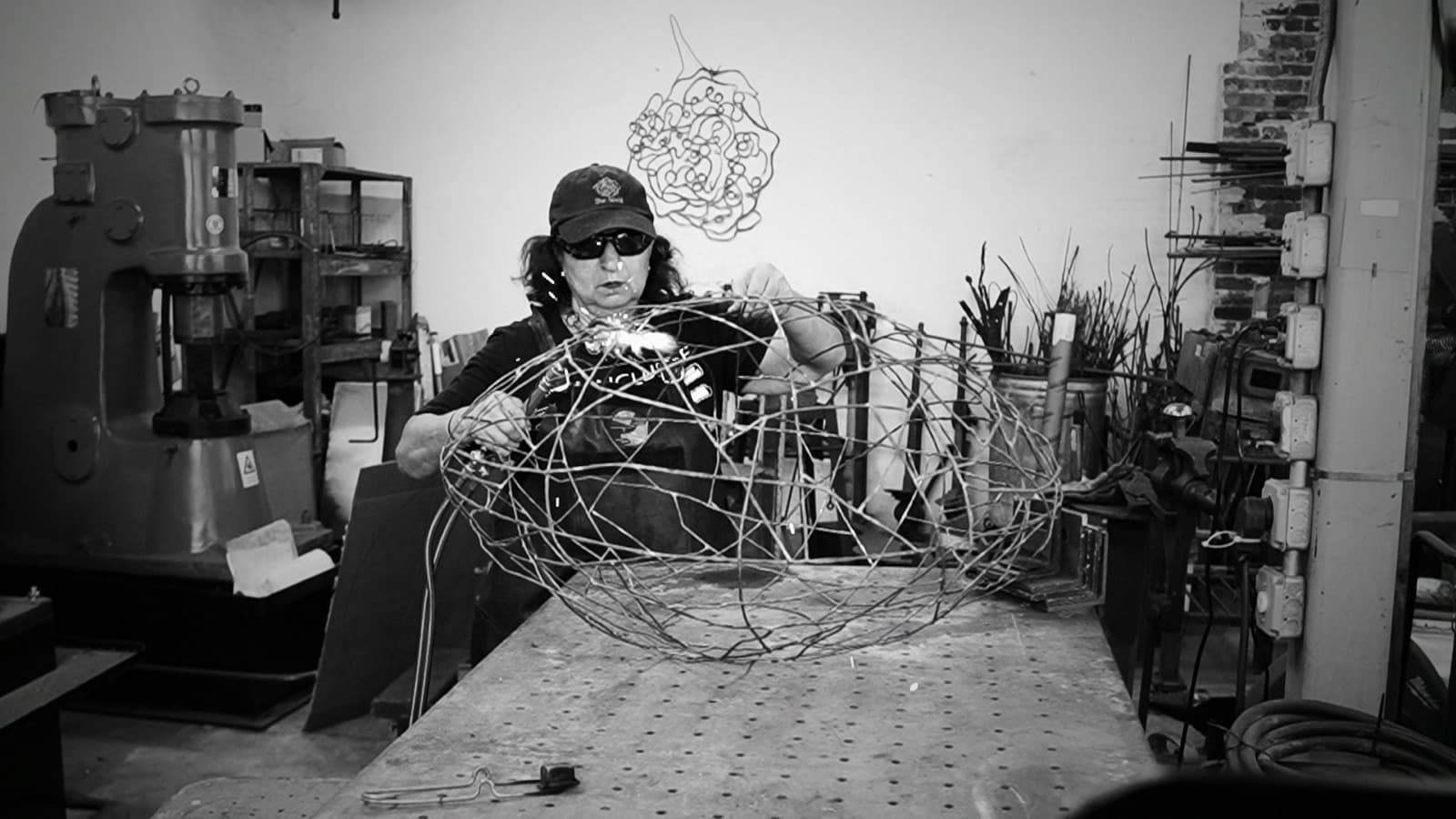
Marsha Trattner's practice shows how wide one career can run across those lanes. Trattner, founder of the Brooklyn studio She-Weld, came to blacksmithing accidentally in the 1990s after meeting a woman who practiced the craft with her husband, who then taught her the technique; her Red Hook studio building was itself a blacksmith shop in the 1800s. She holds an M.F.A. in sculpture from RISD and teaches at the School of Visual Arts while running classes through her studio, and her commissions range from a banister for designer Cynthia Rowley to litter baskets for the NYC Department of Sanitation. "Sometimes just in the moment of the forge, it's so peaceful and I feel like I'm just making an ink drawing," she told News 12 Brooklyn. Her conversation with host Briana Ottoboni is on The Trades Show.
Marsha's unique career is an example of why the artisan trades resist the usual categories of either fine arts or the construction trades, sitting squarely in both territories. They carry the artistry and aesthetic of fine art alongside the training and rigor of a skilled trade, which makes a blacksmith distinct from both the licensed tradesman and the hobbyist.
Tools and skills to build first
Unlike most skilled trades, blacksmithing asks for surprisingly little hardware at the start. ABANA's beginner guide names four items, "a forge, a hammer, tongs, and an anvil," and notes that beginners can substitute improvised gear such as railroad-track anvil-shaped objects and vice grips in place of tongs. A post vise, whose leg carries hammering force into the ground, is the traditional smithing vise and holds hot stock while being struck.
The skills matter more than the kit. Most of them are described in terms of stock, the trade's word for the raw bar of steel you start from, so drawing stock means lengthening and thinning that bar under the hammer, while spreading it means widening it. The New England School of Metalwork defines beginner competence as being "competent to fairly proficient" in forge welding, drawing stock to dimension, spreading stock, and forming tapers and shoulders. Forge welding is usually the hinge skill: guidance for mild steel puts the optimal temperature near 2,300°F, a sparking yellow or white heat, and warns that heating past that point burns the carbon out and ruins the piece. Safety habits form alongside technique, and the same school requires leather boots and full-length pants while supplying eye, hand, and hearing protection.
How to become a blacksmith: the four-stage path
1. Get foundational blacksmith training
Most American blacksmiths begin at a blacksmithing school or craft school rather than a trade school, where the format is workshop immersion, not a credential. Penland School of Craft in North Carolina runs an Iron studio with twelve coal forges and power hammers, capping classes at eleven so each student works a personal forge station. The John C. Campbell Folk School in Brasstown teaches week-long and weekend classes from hammer-and-anvil fundamentals through ornamental ironwork, and Peters Valley in New Jersey runs short intensives on fire maintenance, tapers, and scrolls.
Degree routes exist, though blacksmithing usually lives inside a broader metalsmithing art degree. Southern Illinois University Carbondale describes its program as the only MFA blacksmithing program in the nation, alongside a BFA track, and CSU Long Beach offers BFA, MA, and MFA degrees in Metals & Jewelry with a dedicated outdoor blacksmithing facility. Note: tuition changes yearly, so confirm current costs with the school directly.
However, a structured alternative runs through teaching shops instead of campuses. ABANA's National Curriculum, introduced in 2015, is a self-paced three-level program the organization says is "based on the European model of trade education." Level I ends with a mandatory gate-latch project before a student advances, Level II covers joinery, forge welding, and toolmaking, and Level III is the advanced tier.
| Route | Format | What you leave with |
|---|---|---|
| Craft schools (Penland, John C. Campbell, Peters Valley) | Weekend to week-long workshops, all levels | Studio hours and technique, no credential |
| University metalsmithing (SIU Carbondale, CSULB) | BFA, MA, or MFA, blacksmithing as a concentration | An art degree with forge access and critique |
| ABANA National Curriculum | Self-paced, three levels, taught through affiliates | Level-by-level recognition inside the field |
| Registered apprenticeship (ironwork, fabrication) | 3 to 4 years, paid, classroom plus on-the-job | Journey-level standing and a wage ladder |
2. Find a blacksmith apprenticeship or structured entry
Unlike the classroom routes above, apprenticeship in metalwork takes three shapes, and the union route is the most formalized of them. Ironworkers Local 580 runs a four-year architectural and ornamental program where the first three years meet two evenings a week and fourth-year apprentices train full weekdays, September through June. More broadly, O*NET associates Structural Iron and Steel Workers with nine registered apprenticeship titles running three or four years.
The institutional route runs through museums and historic sites, where Colonial Williamsburg sets the floor at 18 years old with a high school diploma or GED plus general knowledge of 18th-century history.
The informal route has no registry behind it, and it runs through regional guilds rather than national bodies. ABANA lists 80+ affiliate groups across North America, which it calls "the life-blood of the blacksmithing community," and regional hammer-ins bring smiths together to forge and demonstrate. Those gatherings, rather than a job posting, are where much of the mentorship starts.
3. Take the first paid work
Early money in metalwork usually comes from a shop rather than your own commissions, and the first year rarely involves design. An entry hire in an architectural shop spends it on fit-up, grinding, layout, and install ride-alongs, learning the sequence of a job before being trusted with the shaping. Based on what shops and union locals advertise, entry work in architectural and ornamental metal generally posts in the mid-to-high $20s an hour, while journeyman-level union ornamental ironwork runs into the high $30s and low $40s. Both figures move with region and with the shop, so treat them as a shape rather than a rate.
The wider numbers deserve care, because no dedicated federal occupation code exists for blacksmiths. They fall under O*NET 51-4199.00, "Metal Workers and Plastic Workers, All Other," a residual catch-all whose median wage is $45,950 a year, or $22.09 an hour, on 2025 BLS data, across roughly 20,400 workers and about 1,700 projected annual openings in a declining occupation. While reading that figure alone might cause you to write the trade off, don't: it is a median for employed production work inside a catch-all category, not a ceiling. Farriery stretches much further, since full-time farriers averaged $119,770 in gross income in the 2025 American Farriers Journal Business Practices Survey while part-time farriers averaged $26,194. The full pay picture by path sits in our companion piece on what blacksmiths actually earn.
4. Specialize
Once a smith commits to a specialty, the certifying ladders start to matter, and bladesmithing runs the most structured of them. The ABS Journeyman Smith rating requires at least three years as an Apprentice Bladesmith, or two plus an approved course certificate, then a performance test and five flawless knives judged by Master Bladesmith panelists. Master Smith testing adds two more years and ten presented pieces including a Damascus blade, and per Wikipedia's crowdsourced count the ABS recognized 114 Master Bladesmiths as of 2025. That rating can carry a career a long way: Master Smith Josh Smith, who earned the rating at nineteen, co-founded Montana Knife Company in a two-car garage in 2020 and the company now runs a 50,000-square-foot manufacturing facility. Farriery runs a parallel ladder in the American Farriers Association's Certified Farrier, Tradesman, and Journeyman levels, the top of which requires every shoe to be hand-forged to specification within a time limit.
Choosing a specialty is also a business decision. Celeste Flores of Clay and Steel, a studio and teaching shop in Richmond, California, writes that "about 90% of my revenue comes from creating railings," and estimates she would need to sell 400 to 500 small items a month to match that with retail volume. She describes fellow smith Adlai Stein running a mixed model instead: gift items, blades, classes, and occasional architectural jobs. Because the specialty sets the network, the organization a smith joins tends to follow from it.
| Organization | Model | How you join |
|---|---|---|
| ABANA | General body, founded 1973, 80+ affiliates | Paid membership |
| American Bladesmith Society | Blade ladder: Apprentice, Journeyman, Master | Membership, then graded testing |
| Society of Inclusive Blacksmiths | Equity and mentorship community, founded 2018 | No fee; sign the code of conduct |
The Society of Inclusive Blacksmiths began in August 2018 when eleven female blacksmiths gathered at the Cascadia Center for Arts and Crafts in Oregon, and it awards two $2,500 institutional grants to blacksmithing institutions; Trattner's She-Weld is a listed Sibling School. ABANA's trajectory, by contrast, reads as a plateau rather than a climb, since the same roughly 4,000-member figure appears both in 2018 press coverage and in Wikipedia's crowdsourced entry today, with no present-day count published by ABANA itself.
How long blacksmith training takes and what entry costs
However long the training looks from outside, ABANA states that "a novice smith can expect to spend 6 months to complete the Level I curriculum," and gives no fixed timeframe for Level III beyond saying it takes years of practice. The New England School of Metalwork frames its tiers similarly, describing its intermediate level as "3 years of part-time to full-time in the forge" and its advanced level as an additional "4 years of more serious work," implying roughly seven combined years to a proficient skill base. Historically, medieval craft-guild apprenticeships averaged about seven years too.
Startup costs run the other direction. ABANA states plainly that it is possible to get started at home for a few hundred dollars, which makes blacksmithing unusually cheap to test, with boots and eye protection as the non-negotiable items. Grant money exists for training too, and ABANA offers members a $500 education grant for tuition, travel, or materials, plus $250 toward conference costs.
Frequently asked questions about how to become a blacksmith
How long does it take to become a blacksmith?
ABANA says a novice can expect six months to complete its Level I curriculum, which covers beginner fundamentals. Working proficiency takes considerably longer. The New England School of Metalwork describes three years of part-time to full-time forge work to reach its intermediate level, then about four more years for advanced, so plan on years rather than months.
Do you need a degree to become a blacksmith?
No degree is required. Most working smiths train through craft-school workshops, regional guild classes, ABANA's self-paced National Curriculum, or a paid apprenticeship in a shop. Degree routes exist for those who want them, including Southern Illinois University Carbondale, which describes its program as the nation's only MFA in blacksmithing, sitting inside a broader metalsmithing art degree.
Can you make a living as a blacksmith?
Yes, though most working smiths combine income streams. Entry work in architectural and ornamental metal generally advertises in the mid-to-high $20s an hour, and journeyman-level union ornamental work runs into the high $30s and low $40s. The ceiling runs well past that: full-time farriers averaged $119,770 in gross income in the 2025 American Farriers Journal survey. Studio smiths typically lean on one dominant specialty, as Celeste Flores does with railings at about 90% of her revenue.
How much does it cost to start blacksmithing?
ABANA states it is possible to begin at home for a few hundred dollars, since the core kit is a forge, a hammer, tongs, and an anvil, and beginners often improvise with railroad track and vice grips. Class tuition varies by school and changes yearly, so confirm costs directly. ABANA also offers member education grants.
Where to look next
While the craft is old, the way you find the work doesn't have to be. Our intention is to use the most advanced tools we have to support the most ancient work we do.
Browse metalwork roles on The Corral's jobs board, and if a shop apprenticeship is what you want, inquire about open apprenticeships. Read the pay picture first in what blacksmiths earn and artisan trade salaries, and if you are still weighing whether this work fits, start with what counts as an artisan trade and how to get an artisan job with no experience. You can also see where working artisans cluster on the Artisan Map or scan residencies, fellowships, and grants.