
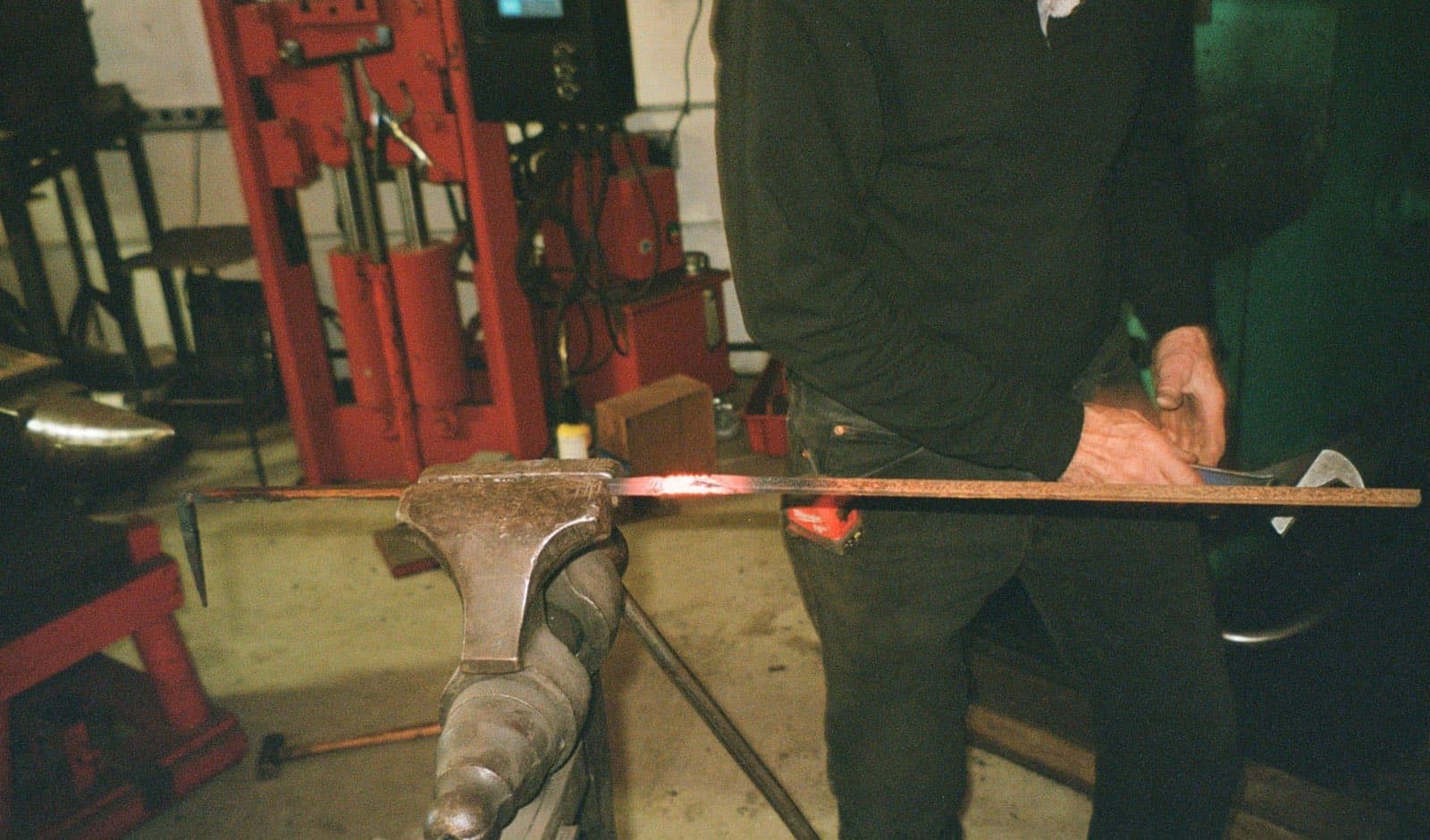
An artisan trade is skilled craft work that makes or repairs physical objects largely by hand, practiced as a livelihood rather than a hobby. The English word traces to the Latin artitus, meaning "skilled" (Etymonline). The category covers leatherworkers, bladesmiths, glassblowers, blacksmiths, furniture makers, and restoration specialists: people who train for years, usually through apprenticeship, and earn a working wage from the skill of their hands.
The artisan is distinct from the skilled tradesman or the hobbyist. The artisan trades sit at the center of the Venn diagram between fine arts and skilled trades. They require the artistry and aesthetic of fine arts, but they also require the same training and rigor of the skilled trades. And while the hobby doesn't have to pay, a trade does. Below is what the six crafts actually earn in 2026, how people break into each one, and who is hiring right now.
What separates an artisan trade from a skilled trade, and from a hobby
Start with the government's own filing cabinet. Electricians, plumbers, and HVAC techs live under the Bureau of Labor Statistics major group 47-0000, "Construction and Extraction Occupations". Cabinetmakers, jewelers, glassblowers, and leatherworkers live one drawer over, in 51-0000, "Production Occupations." Two different branches of the same tree. The licensed skilled trades install and build the systems a building runs on. The artisan trades make and repair the objects.
The line matters because the licensed trades are gated by law. You need a license to wire a house. No state licenses a bladesmith. What gates an artisan trade instead is skill transmission, passed hand to hand, the same structure medieval guilds used: apprentice, journeyman, master, with a "masterpiece" submitted to prove mastery (guild history). That ladder is old. In 1395 the Mayor of London formally forbade cobblers from working new leather and cordwainers from repairing old shoes, splitting one trade into "maker of new" and "repairer" by ordinance (Wikipedia). The maker-versus-repairer distinction is that literal, and that ancient.
Then there's the other line, the one between trade and hobby. This one is economic, and it's roughly an order of magnitude wide. Etsy's 5.6 million active sellers grossed about $1,900 each in average annual sales in 2025, and that's gross sales, before fees and materials. Compare that to the lowest-paid trade on this list, shoe and leather repair, which still clears a $37,800 median. Skill is the prerequisite. Wikipedia's definition of an artisan is exactly that: "a skilled craft worker who makes or creates material objects partly or entirely by hand", and historically the term never included unskilled labor.
The six artisan trades, at a glance
| Trade | What they make or do | How people get in | Median Pay (2026) |
|---|---|---|---|
| Leatherwork, shoemaking, cobbling | Construct and repair shoes, boots, saddles, luggage | Shop apprenticeship, training programs (no formal trade schools left in the U.S.), factory or atelier training | $37,800 median; factory floor from $24.60/hr |
| Bladesmithing, knifemaking | Forge and grind knives and blades | ABS certification path, schools, self-taught practice | $45,950 median employed; mid-tier custom $60K–$120K |
| Glassblowing, glasswork | Blow and shape glass: production, studio art, scientific apparatus | Salem CC degree, studio workshops, apprenticeship | $46,170 median; scientific ~$79K–$81K |
| Blacksmithing, metalsmithing | Forge iron: architectural, farriery, ornamental, restoration | ABANA curriculum, apprenticeship, farrier certification | No BLS code; farriers avg $119,770 |
| Woodworking, furniture making | Build cabinetry and furniture, from production to studio | Trade schools (NBSS, Krenov), apprenticeship | $46,680 median; custom self-employed $50–$75/hr |
| Restoration, repair, conservation | Restore and repair historic buildings, furniture, and everyday objects | Conservation degree, preservation-trades school, or shop apprenticeship | $51,440 median; private work varies |
Note: the BLS does not track most of these as clean occupations. There is no federal code for "blacksmith" at all, so hand metalworkers get swept into a catch-all bucket, 51-4199, for which O*NET collects no detailed data. Studio furniture makers and independent bladesmiths are mostly self-employed and fall outside the wage surveys entirely. These are also medians for employed production work, not ceilings: at the top of every craft on this list, the work becomes a coveted object with a price to match. Where the official numbers undercount the skilled end of a trade, the gap is noted below.
Leatherwork, shoemaking, and cobbling
The government median for Shoe and Leather Workers and Repairers is $18.17 an hour, or $37,800 a year. It's the smallest of the six occupations, around 9,500 workers, with only about 900 openings projected over the entire 2024–2034 decade. While reading that statistic alone might cause you to write the trade off, don't.
This number is referring to a vanishing solo-repair craft, rather than the trade as a whole. U.S. shoe-repair shops have collapsed from roughly 120,000 in 1928 to below 3,500 today, and the remaining cobblers are aging out with few apprentices behind them. Jim McFarland, a fourth-generation cobbler, put it plainly: "There's not that many cobblers in their 30s and 40s." There are no formal shoe-repair trade schools left in North America; the way in is an apprenticeship with an existing shop or a private training program.
However, there's another way in. The same exact skill of cutting, stitching, and finishing leather is hired at scale by heritage manufacturers and luxury houses. Red Wing Shoe Company employs more than 2,100 people across two U.S. factories and still starts production by hand-cutting leather; it has advertised factory floor jobs at a $24.60-an-hour starting wage. Hermès recruits more than 200 craftspeople a year into its leather-goods division, most of them absolute beginners, and trains its master artisans for roughly six years to reach full command of the saddle stitch. One trade, two economies. And there's a third tier, where the work becomes a coveted object: Lisa Sorrell's bespoke cowboy boots start at $10,000 a pair and come with an eighteen-month wait, while Lee Miller's Texas Traditions boots, starting at $5,000, hold a five-year waiting list.
Bladesmithing and knifemaking
Bladesmiths get filed under "Metal Workers, All Other," a category with a median of $22.09 an hour, or $45,950. That's the employed-on-a-production-line floor. The independent range is enormous. A mid-tier custom maker with a following typically invoices $60,000 to $120,000 a year, and established studios run past $150,000, but per BLADE Magazine fewer than 2% of knifemakers worldwide are full-time. The professional bladesmith David Roeder is blunt about the early years: "Being a full-time bladesmith and making money to survive right out of the gates isn't going to happen. You're going to starve."
Unlike other artisan trades, bladesmithing has a defined credentialing ladder. The American Bladesmith Society requires three years of membership before you can even test for Journeyman Smith, and Master Smith demands a Damascus blade of at least 300 layers plus a battery of cutting and flex tests. As of 2025 there are only 114 ABS Master Smiths. On the employed side, named makers hire: Buck Knives runs more than 300 people in Post Falls, Idaho, Benchmade employs 400-plus in Oregon City, and W.R. Case has forged knives in Bradford, Pennsylvania for over a century.
Glassblowing and glasswork
Glassblowing is the clearest case of the official number burying what the work actually pays. O*NET lists Glass Blowers, Molders, Benders, and Finishers at $46,170 a year, and the occupation is one of the two on this list BLS expects to grow faster than average, at 5 to 6% with about 5,500 openings a year. But that median lumps production-line glass work in with everything else. Look at the specialized tier and the numbers change: a scientific glassblower averages around $79,000 to $81,000, with top earners near $142,000. The studio-art ceiling runs higher still: Lino Tagliapietra's hand-blown work has brought $118,750 at auction, and a Dale Chihuly chandelier sold for $200,000 against a $60,000 estimate.
Scientific glassblowers build the custom apparatus that research labs, semiconductor fabs, and MRI systems can't buy off a shelf, and there are very few of them. The American Scientific Glassblowers Society has shrunk to about 650 members, down from roughly 1,000 a half-century ago. Salem Community College in New Jersey runs the only scientific-glass degree program of its kind in the country, and places graduates directly at P&G, 3M, the NIH, and Caltech. The studio-art side trains separately, through workshops and residencies at places like Pilchuck and UrbanGlass, and Corning launched a new two-year Glassmaking Institute in 2025.
Blacksmithing and metalsmithing
Traditional blacksmithing is hidden in most statistics. There is no BLS wage series for blacksmith or ornamental ironworker. The closest proxies are structural iron and steel workers at a $62,700 median and sheet metal workers at $60,850. The strongest income proof point sits outside government data entirely: full-time farriers, the smiths who shoe horses, average about $119,770 a year per the American Farriers Journal survey, and those aged 30 to 39 average closer to $139,411.
The professional community is organized, though it is no longer growing the way it once did. The Artist-Blacksmith's Association of North America grew from 27 charter members in 1973 to roughly 4,000 today, but nearly all of that growth came in its first two decades — membership had already reached about 3,800 by 1996 and has held roughly flat since. Architectural forges hire and endure: Finelli Iron Works in Ohio has run since 1961, Woodbury Blacksmith in Connecticut since 1970. The objects hold their value for generations, too: an original hand-forged gate by the Philadelphia master Samuel Yellin is priced at $65,000 on today's architectural-antiques market. And restoration keeps the craft alive in place. In New Orleans, third-generation smith Darryl Reeves has rebuilt historic ironwork across the city, including a Cabildo fence remade from 1790s plans (news feature).
Woodworking and furniture making
Cabinetmakers and Bench Carpenters earn a $46,680 median across about 86,000 workers. BLS projects the headcount to dip slightly through 2034, but replacement need still opens roughly 8,100 jobs a year. Self-employed custom makers report $50 to $75 an hour, though income there swings hard on business model, and the working makers who do best mix building with teaching and commission work rather than selling finished pieces on spec.
As a challenging craft to learn, woodworking has a handful of notable training programs, running from nine-month intensives to multi-year courses. North Bennet Street School in Boston, the country's oldest trade school (incorporated 1885), runs a two-year, 2,340-hour Cabinet & Furniture Making program; the Krenov School in California runs a nine-month intensive. The ceiling is real: Sam Maloof handcrafted some 5,000 pieces and in 1985 became the first craftsperson to win a MacArthur "genius" grant, and both Presidents Carter and Reagan owned his rocking chairs. He still called himself a woodworker. "I like the word," he said. "It's an honest word." The market repays that honesty: his rocking chairs have brought as much as $80,500 at auction, and a commissioned George Nakashima dining table has sold for $204,000. Even the U.S. Senate employs a Furnishings Artisan to build and repair cabinetry for the Capitol.
Restoration, repair, and conservation
Restoration splits into two tracks. Museum and object conservation is BLS-countable: Museum Technicians and Conservators earn a $51,440 median, and the field is projected to grow faster than average with about 1,900 openings a year. The building-preservation trades, carpentry and plaster and timber framing, train through apprenticeship-style schools rather than a single occupation code.
The demand here is unusually well quantified. A national labor study found the U.S. needs nearly 100,000 additional historic-trades workers over the next decade, against roughly 261,000 historic properties undergoing rehab each year. Training programs report the payoff: North Bennet Street's Preservation Carpentry program posted 91 to 100% employed-in-field rates for recent cohorts, placing graduates with the National Park Service, Historic New England, and the Peabody Essex Museum. At the American College of the Building Arts in Charleston, dean Christina Butler is direct about the shortage: "There are not enough craft people in this state, let alone in Charleston to be able to do all of this work."
Then there's repair, the everyday end of the same instinct, and quietly one of the healthiest corners of the artisan economy. U.S. shoe-repair revenue has grown about 3.9% a year, reaching $315.6 million in 2025, even as the number of shops shrinks — meaning the cobblers still standing are busier, with New Hampshire shops reporting their best winter seasons in nearly twenty years. Tailors are seeing the same turn: the global alterations market, roughly $9 billion in 2024, is growing on sustainability demand, the London repair service Sojo grew orders 300% in a year and now runs repair counters inside Selfridges and Marks & Spencer, and Patagonia's Worn Wear program performs tens of thousands of garment repairs a year. Cobblers, tailors, and menders show up on our own board alongside the making trades, including bespoke-tailoring roles at houses like Hermès.
What separates craft that pays from craft that doesn't
Most people who make things by hand don't earn a living at it, but the ones who do share a pattern.
On the hobby side, a 2018 survey of over a thousand visual artists found only 10% worked full-time on their art, and half earned 10% or less of their income from it. The UK Crafts Council's 2025 survey of makers drew the line cleanly within one population: 38.3% full-time, 45.7% part-time, 16% hobbyist.
The primary distinction between these groups is not talent or skillset, but business model. Hobbyists rely on product sales alone. Professionals diversify: they build, they repair, they teach, they take commissions. In woodworking, teaching classes is described as many times more profitable than selling finished furniture, and commission work outpaces speculative retail. Plus, repair trades add something that product-makers don't have: recurring customers. A cobbler or a knife sharpener sees the same client back again and again, and that repeat business gives a repair shop an income floor that hobby sales rarely provide. The stakes here run past any one maker's income. Heritage Crafts, which grades UK craft viability like an endangered-species list, defines a craft as viable only if there are enough craftspeople to transmit the skills to the next generation — and skills only transmit where the work pays. A craft that can't support a living is a craft that can't reproduce itself.
Which of these trades is hiring right now
The Corral's board lists artisan roles from employers that range from independent studios to Hermès, Chanel, Tiffany & Co, and the U.S. Department of the Interior. We use modern tooling, AI included, to surface those jobs from company career pages and pull them into one place. While the craft is old, the way you find the work doesn't have to be. Our intention is to use the most advanced tools we have to support the most ancient work we do.
The wider labor data supports the growth in modern trade jobs. A JLL report estimates the U.S. skilled-trades shortage could cost the economy up to $1 trillion a year, with 2.1 million positions unfilled by 2030. Last year, 600,000 skilled-trades jobs were posted against only 150,000 new workers entering through apprenticeships. And the next generation is moving toward the work: the share of teenagers considering trade school more than doubled, from 12% in 2018 to 30% in 2024.
The demand side is moving the same direction. The U.S. handicrafts market reached $345 billion in 2025 and is projected to nearly double by 2034, and Hermès' hand-stitched leather-goods division grew 11.3% in the first half of 2025 while the broader luxury market slowed. People increasingly want the made thing, and someone has to make it.
Note: of the six crafts here, only glassblowing and conservation are projected by BLS to grow faster than average. Leatherwork, cabinetmaking, and the rest are flat to slightly declining in official headcount, propped up by replacement need as an older generation retires. The cultural demand for real craft is rising faster than the institutional support for some of these occupations.
Where to start
Pick the trade, then find the door. Each craft has its own pathway in, and over the coming weeks we're publishing a guide to each of the six, from shoemaking to bladesmithing, along with a side-by-side 2026 salary breakdown. Set a job alert and you'll catch each one as it lands.
When you're ready to see who's hiring, browse the open roles on the Jobs board and set a job alert so new listings in your trade come to you. If apprenticeship is your route in, inquire about open apprenticeships. If you're just getting started, the Opportunities board tracks the residencies, fellowships, and grants that fund early-career artisans, and the Artisan Map can point you to makers and shops near you.
Frequently asked questions
What is the difference between an artisan trade and a skilled trade?
Skilled trades like electrician and plumber install and maintain a building's systems and are licensed by the state. Artisan trades make or repair physical objects by hand and are gated by skill rather than a license. The federal government even files them separately: licensed trades under Construction and Extraction, artisan crafts under Production Occupations. Both are skilled work; the difference is what you make and how you're certified.
Which artisan trades pay the most?
Farriery leads: full-time farriers average about $119,770 a year. Scientific glassblowers average around $79,000 to $81,000 with a ceiling near $142,000. Established independent bladesmiths can clear $150,000, though few do. The lower-paid end, shoe and leather repair, still runs a $37,800 median. Specialization and going independent raise the ceiling most.
Do you need a degree to work in an artisan trade?
Almost never a four-year degree. For cabinetmaking, 62% of employers require only a high school diploma. Most trades train through apprenticeship or dedicated trade schools like North Bennet Street or Salem Community College, not university. The exceptions are institutional roles: museum conservation typically wants a bachelor's or master's. The standard path in is hands-on training under someone who already has the skill.
Are artisan trades a dying career?
Some occupations are shrinking in official headcount, but the trades themselves are not dying. An older workforce is retiring faster than replacements arrive, which means openings, not obsolescence. A national study found the U.S. needs nearly 100,000 more historic-trades workers this decade. Glassblowing and conservation are projected to grow faster than average. The bigger risk is too few trained hands, not too little demand.